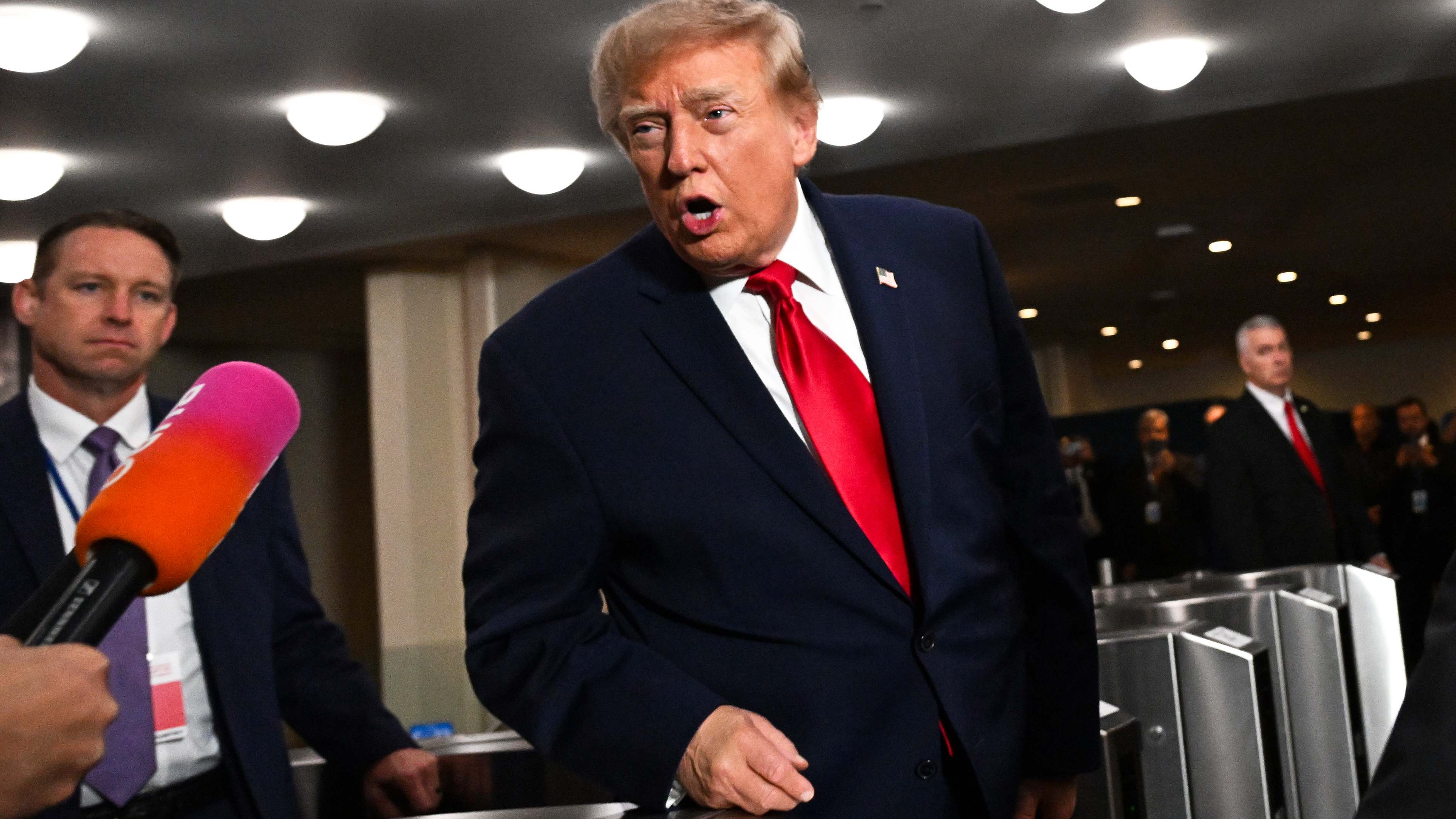
In the high-stakes arena of international diplomacy, every word and gesture of a world leader is under scrutiny. However, when President Donald Trump arrived at the United Nations recently, the focus shifted not just to global policy, but to a direct and fiery confrontation with a member of the American press.
In this in-depth analysis, we examine the heated exchange between Trump and CNN journalist Kaitlan Collins, the claims regarding media bans, and what this friction signifies for the relationship between the White House and the press.
📑 Table of Contents
1. The UN Confrontation: A Clash of Worlds
The United Nations General Assembly serves as a stage for global leaders to discuss security, climate, and economic cooperation. But during the recent visit, the atmosphere was charged with domestic political tension rather than international diplomacy. As Trump entered the doors of the U.N., he was met not just by foreign dignitaries, but by the lens of the American media.
The encounter was immediate. Trump, addressing Kaitlan Collins directly, stated clearly that she should not be there covering him. This moment highlighted the long-standing friction between the President and major news networks, which he has frequently characterized as biased or hostile toward his administration.
The Symbolism of the Public Stage
By confronting a journalist in front of a global audience, Trump utilized the international platform to communicate with his domestic base, signaling a defiance of the mainstream media establishment. It was a calculated move to bypass traditional press protocols.
2. The Anatomy of the Media Ban Allegations
Central to Trump's outburst was the claim that CNN had previously stated they would not cover him. He told Collins, 'I'm surprised that CNN is here covering me. You should not be here covering me. You said you weren't going to cover me.' This narrative is a recurring theme in his presidency—the idea that certain media outlets are ideological outcasts.
However, the facts on the ground are more complex. While the administration has occasionally restricted access to certain journalists or press briefings, the notion of a blanket 'ban' on a major network like CNN remains a point of intense debate among legal experts and political analysts.
Deconstructing the 'Ban' Narrative
The term 'ban' is often used rhetorically to describe access restrictions or the critical tone of the coverage. Trump uses this language to frame the media as an adversary rather than a neutral observer of government.
3. CNN's Response and Journalistic Integrity

Following the encounter, Kaitlan Collins noted on-air that CNN had made no such claim about not covering the President. For the organization, the mission is to report on the actions of the government, regardless of whether the government welcomes their presence. To CNN, the presence at the UN is a fundamental requirement of their journalistic role.
Journalists like Collins argue that the role of the press is to hold power to account. The attempt to bar them from these events is seen by many as an attempt to stifle transparency. This clash represents a fundamental disagreement on what the role of the media is in a functioning democracy.
The Challenge of Modern Reporting
In an era of polarized media, journalists face immense pressure from both the public and the subjects they cover, making physical and verbal confrontations more volatile than ever before.
4. The Broader Implications for US Press Freedom
This incident goes beyond a single news story; it touches upon the First Amendment. When a sitting president tells a journalist they 'should not be here,' it raises questions about the limits of executive power and the rights of the press to gather information. Historically, the press has had broad access to official government proceedings.
Civil liberties groups have expressed concern that such rhetoric could lead to a dangerous precedent. If journalists are selectively excluded based on the perceived leanings of their coverage, the public's access to vital information about their leaders could be severely compromised.
Legal Precedent and Executive Privilege
The legal framework surrounding press access generally protects the right of the media to attend public events, but the line becomes blurred in private meetings or high-security international summits.
5. The Future of of Presidential-Media Relations
As we look forward, the relationship between the White House and the media appears set to remain combative. The confrontation at the UN is not an isolated incident but a continuation of a broader strategy to challenge traditional media gatekeepers in favor of direct communication with supporters.
For the media, the challenge will be to navigate an environment where they are increasingly viewed as opposition. For the administration, the strategy is to maintain a narrative that is independent of traditional news cycles. This dynamic will likely continue to shape the political landscape in the years to come.
Navigating the New Media Landscape
The evolution of digital communication and social media allows leaders to bypass the press entirely, making the traditional journalist role even more contentious in the political discourse.
🔥 Subscribe to Azeem-USA for more deep dives into global politics and media trends.
Conclusion
The clash between Donald Trump and Kaitlan Collins at the United Nations underscores the deep divide between the executive branch and the mainstream media. While Trump claims a media ban is occurring, the press asserts its right to report on global events. This tension is likely to persist, redefining how information is consumed and how leaders interact with journalists in the 21st century.
❓ FAQ
What did Trump say to Kaitlan Collins at the UN?
He told her she should not be there covering him and claimed CNN had said they wouldn't.
Did CNN actually stop covering coverage of Trump?
CNN stated that they made no such claim and intended to cover the President.
Is there a legal ban on journalists at the UN?
There is no legal ban on journalists from covering the UN General Assembly, though access can be managed.
What does this mean for press freedom?
It highlights growing tensions regarding the right of the press to access official government events.
Who is Kaitlan Collins?
She is a prominent journalist at CNN known for her coverage of the White House and political events.
Comments
Post a Comment