
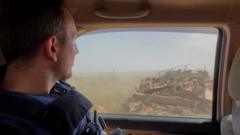
In a world often saturated with headlines, certain reports offer a rare and vital window into regions marked by complex geopolitical realities. The BBC's recent dispatch from southern Lebanon, providing a glimpse into areas under Israeli occupation, stands out as one such critical journalistic endeavor. This report offers an invaluable perspective on a territory that rarely features prominently in global discourse, beyond conflict narratives.
At Azeem USA, we believe in dissecting such significant news to understand the broader implications for international relations, humanitarian efforts, and the lives of those directly affected. This post delves into the core findings and implications of the BBC's report, offering an authoritative and forward-thinking analysis for our readers.
📑 Table of Contents
1. Understanding the Context: Southern Lebanon's Strategic Importance
Southern Lebanon has long been a focal point of regional tensions, its strategic location bordering Israel making it a critical zone for both Lebanese sovereignty and Israeli security concerns. For decades, this area has witnessed significant military and political activity, profoundly shaping the lives of its inhabitants and the broader regional dynamics. The BBC's access, facilitated by a humanitarian convoy, signifies a rare opportunity to move beyond established narratives and observe the ground realities firsthand.
The historical context is crucial for understanding the current situation. Following various conflicts and military engagements, parts of southern Lebanon have experienced periods of Israeli presence and control, leading to a complex web of political, social, and economic consequences. This situation has fostered a unique environment where humanitarian needs often intersect with deeply entrenched security considerations, making objective reporting a challenging yet essential task.
Border Security and Control
The report implicitly highlights the ongoing Israeli security operations and control mechanisms along the border. This control impacts movement, access, and the daily lives of civilians, creating a situation that is both precarious and highly sensitive.
2. The Humanitarian Convoy: A Lifeline Amidst Tensions
The journey undertaken by the BBC's Hugo Bachega was not a routine news assignment but a part of a humanitarian convoy. This detail is significant, as it underscores the challenges of accessing such sensitive areas and highlights the critical role of aid organizations in providing essential services. These convoys often represent a lifeline for communities facing shortages and disruptions due to the prevailing political and security climate.
Travelling with aid workers provides a unique vantage point, allowing journalists to witness the immediate needs of the population and the efforts being made to address them. It also offers a chance to interact with individuals whose lives are directly impacted by the occupation, providing personal stories that humanize the broader geopolitical narrative. The presence of a humanitarian convoy suggests that the region faces significant challenges that require external support.
Challenges in Aid Delivery
The report likely touches upon the difficulties faced by humanitarian groups in delivering aid effectively and safely within occupied territories, navigating both logistical and political hurdles.
3. Life Under Occupation: Daily Realities and Challenges

The BBC's report offers a rare glimpse into the daily lives of people living under what is described as Israeli occupation in southern Lebanon. This access allows for a more nuanced understanding of the human impact of prolonged military presence and control. Beyond the headlines of conflict, the report likely delves into the everyday struggles, adaptations, and resilience of the local population.
Observing life in these areas provides critical insights into how communities function under such unique and often restrictive circumstances. It sheds light on issues such as freedom of movement, economic opportunities, access to essential services, and the psychological toll of living in a territory with contested sovereignty. The BBC's footage and reporting aim to bring these often-overlooked aspects of life to the global stage.
Community Resilience and Adaptation
The report likely showcases the remarkable resilience of the local communities, who have developed coping mechanisms and ways of life amidst the ongoing occupation and its associated challenges.
4. Geopolitical Undercurrents: Regional Implications
The situation in southern Lebanon is intrinsically linked to broader geopolitical currents in the Middle East. Any report that provides a clearer picture of the ground situation under Israeli occupation has significant implications for understanding regional stability, international relations, and the ongoing Israeli-Palestinian conflict, as well as broader Arab-Israeli relations.
The BBC's report, by offering a rare look into this sensitive zone, contributes valuable data points for analysts, policymakers, and the international community. It helps to illuminate the complexities that often define this volatile region, potentially influencing diplomatic efforts and public perception. Understanding the dynamics within southern Lebanon is key to grasping the multifaceted challenges and potential pathways towards de-escalation and peace.
Border Tensions and Security Concerns
The report likely touches upon the persistent border tensions and the security concerns that have historically characterized the Lebanon-Israel frontier, influencing regional military postures.
5. The Power of Journalism: Illuminating Hidden Narratives
Journalism plays an indispensable role in bringing visibility to areas and situations that might otherwise remain in the shadows of global awareness. The BBC's ability to gain rare access to occupied southern Lebanon is a testament to the persistent efforts of journalists to report from challenging environments, providing essential context and human stories.
Such reporting is crucial for fostering informed public discourse and encouraging accountability. By moving beyond generalized narratives and providing specific, on-the-ground accounts, the BBC's work helps to foster a deeper understanding of the complexities at play. This commitment to illuminating hidden narratives is vital for the pursuit of truth and the promotion of dialogue in sensitive geopolitical contexts.
Bridging Information Gaps
This journalistic endeavor serves to bridge critical information gaps, offering audiences a more comprehensive and grounded perspective on a critical geopolitical flashpoint.
🔥 Stay informed with Azeem USA's expert analysis on global affairs and geopolitical trends.
Conclusion
The BBC's report from occupied southern Lebanon, facilitated by a humanitarian convoy, offers a profoundly important and rare insight into a region often defined by its contested status and strategic significance. It underscores the complex interplay of security, humanitarian needs, and daily life under conditions of occupation.
As we continue to monitor developments in the Middle East, reports like these serve as crucial reminders of the human element within geopolitical struggles. Azeem USA remains committed to providing analysis that looks beyond the headlines, fostering a deeper understanding of the forces shaping our world and highlighting the importance of informed perspectives.
❓ FAQ
What specific area of southern Lebanon did the BBC report from?
The BBC's Hugo Bachega gained rare access to a part of southern Lebanon that is under Israeli occupation, traveling with a humanitarian convoy.
What is the significance of a humanitarian convoy in this context?
A humanitarian convoy signifies the presence of critical aid and support for the local population, and its presence highlights the challenging living conditions and potential shortages in the region.
Why is southern Lebanon a strategically important region?
Southern Lebanon's strategic location bordering Israel makes it a critical zone for regional security dynamics, historical conflicts, and geopolitical considerations.
What are the main challenges of reporting from occupied territories?
Reporting from occupied territories often involves navigating significant logistical hurdles, security risks, and political sensitivities, making access and objective reporting challenging.
How does this BBC report contribute to understanding the Middle East conflict?
By providing rare on-the-ground insights into life under occupation in southern Lebanon, the report helps to humanize the conflict, illuminate complex realities, and contribute valuable context to ongoing geopolitical discussions.
Comments
Post a Comment