
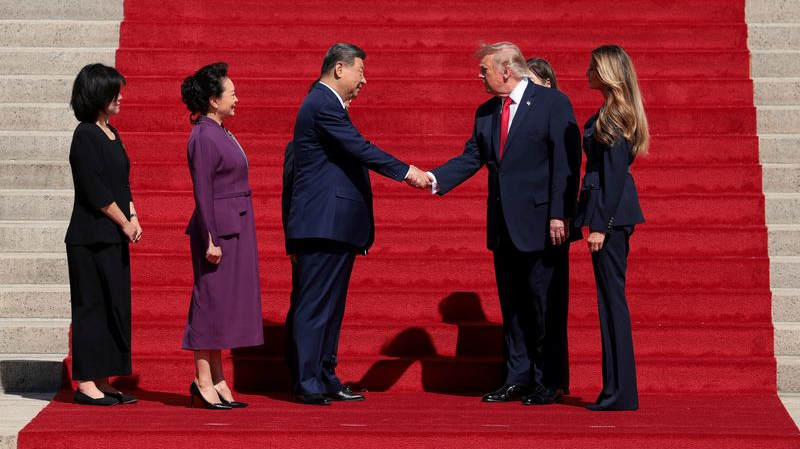
The global economic landscape just experienced a seismic shift. After years of intense friction and escalating trade barriers, the United States and China have signaled a significant pivot toward cooperation. This move is not merely a temporary pause; it is a strategic realignment that could redefine how the world's two superpowers interact for decades.
In this deep dive, we deconstruct the details of the $30 billion tariff cut, the formation of the new trade council, and what the inclusion of AI dialogue means for the future of technology.
📑 Table of Contents
1. The Eight-Point Consensus: Analyzing the Shift
The recent visit of President Xi Jinping to Washington has culminated in an eight-point consensus that is being hailed as a landmark in diplomacy. This agreement represents a departure from the confrontational rhetoric of recent years, moving instead toward a structured framework for engagement. By establishing clear parameters, both nations are acknowledging that the cost of unrestricted economic warfare has become too high for their domestic markets.
This consensus suggests that both sides are seeking to stabilize their respective economies. While the specifics of every point are still under review, the overarching goal is clear: to de-escalate tensions that have threatened global supply chains and investor confidence worldwide.
The Diplomacy of Kuala Lumpur
The agreement didn't happen in a vacuum. It builds upon the groundwork laid during talks in Kuala Lumpur, showing that consistent engagement is finally yielding tangible results for both nations.
2. The $30 Billion Reciprocal Tariff Reduction
At the heart of this deal is a $30 billion reciprocal tariff-reduction arrangement. This figure is significant because it addresses the immediate financial pressure placed on importers and consumers in both countries. For businesses operating across the Pacific, this tariff cut represents a potential windfall in cost savings and a more predictable pricing environment.
The reciprocal nature of the deal is key. It ensures that neither side feels they are making unilateral concessions. By lowering barriers in a synchronized manner, the US and China are attempting to restore a balance of trade that was disrupted by the aggressive protectionist policies of the past years.
Impact on Global Supply Chains
With these tariffs dropping, we expect to see a shift in manufacturing sourcing strategies, potentially moving back toward models that were deemed efficient before the height of the trade war.
3. Establishing the Bilateral Trade Council

Beyond the immediate financial relief, the agreement to set up a dedicated trade council is a forward-looking move. Unlike ad-hoc meetings, a formal council provides a permanent forum for resolving disputes before they escalate into full-scale wars. This institution is designed to manage the complexities of modern trade, which goes beyond simple commodities.
The council will likely focus on addressing sensitive issues such as intellectual property, market access, and regulatory standards. By having a structured body oversee these issues, the US and China are reducing the risk of volatile policy shifts that could shock the markets.
Institutionalizing Cooperation
The trade council acts as a safeguard for the trade truce, ensuring that dialogue continues even when political climates in either Washington or Beijing cool.
4. Artificial Intelligence: The New Frontier
Perhaps the most intriguing aspect of the consensus is the agreement to launch a formal dialogue on Artificial Intelligence. As AI becomes the primary driver of future industrial growth, both the US and China recognize that an unregulated arms race could lead to catastrophic global outcomes. This dialogue is intended to establish 'rules of the road' for this technology.
This discussion will likely cover AI safety standards, ethical considerations, and the role of AI in military applications. By talking through this now, the two superpowers are attempting to set the global standards for AI rather than leaving it to be decided by a fragmented group of actors.
The Strategic Importance of AI
Focusing on AI shows that while the nations are competitors, they are also aware of the shared risks associated with unmanaged technological development.
5. Future Outlook: Will Stability Last?
While the $30 billion cut and the trade council are massive steps, skepticism remains necessary. The extension of the trade truce by two months provides a necessary breathing room, but it is not a permanent peace treaty. The true test of this agreement will be how the trade council handles the first major dispute that inevitably arises.
If the two nations can adhere to this framework, we may enter a new era of 'competitive cooperation,' where they compete in market share but cooperate to prevent global economic collapse. However, domestic political pressures in both countries will continue to pose a threat to this fragile equilibrium.
Monitoring the Road Road Ahead
The world is watching closely, as the success of this eight-point consensus will dictate the economic trajectory of the next decade.
🔥 Subscribe to Azeem USA for more deep analysis on global trade and economic shifts.
Conclusion
The $30 billion tariff cut and the establishment of a trade council mark a pivotal moment in US-China relations. While challenges remain significant, the shift toward structured dialogue and AI cooperation suggests a pragmatic desire for global stability.
We will continue to monitor how these agreements evolve and what they mean for the international markets.
❓ FAQ
What is the total value of the tariff cut?
The agreement involves a $30 billion reciprocal tariff-reduction arrangement.
What is the trade council?
It is a newly established body designed to resolve trade disputes and manage bilateral economic relations.
Is AI included in the trade deal?
Yes, both nations agreed to launch a formal dialogue on AI policy and safety.
When did the previous trade truce expire?
The truce was extended by two months, allowing more time for these negotiations.
Does this mean the trade war is over?
No, it represents a de-escalation and a shift toward cooperation, but competition remains.
Comments
Post a Comment