BREAKING: Ukraine Resumes Russian Refinery Strikes After US Ceasefire 🚨 Breaking News Analysis 📸 Image Credit: yahoo.com By Azeem-USA · Thu Oct 15 2026 English (en-US) Ukraine has officially resumed its strategic campaign against Russian energy infrastructure, launching a precision strike on a refinery in the Ryazan region on Thursday. This escalation marks a definitive break from the temporary energy ceasefire demanded by the United States, coming immediately after President Volodymyr Zelensky expressed public fury over the withdrawal of American intelligence support. This analysis examines the immediate impact of the Ryazan strike, the breakdown of the US-led energy truce, and the broader implications for the conflict and global energy markets. 📑 Table of Contents The Ryazan Strike: Kyiv Hits Back The Trump Energy Ceasefire Collapse Zelensky's Intelligence Ultimatum Economic Warfare and Global Fuel Volatility The Geopolitical Fallout: W...

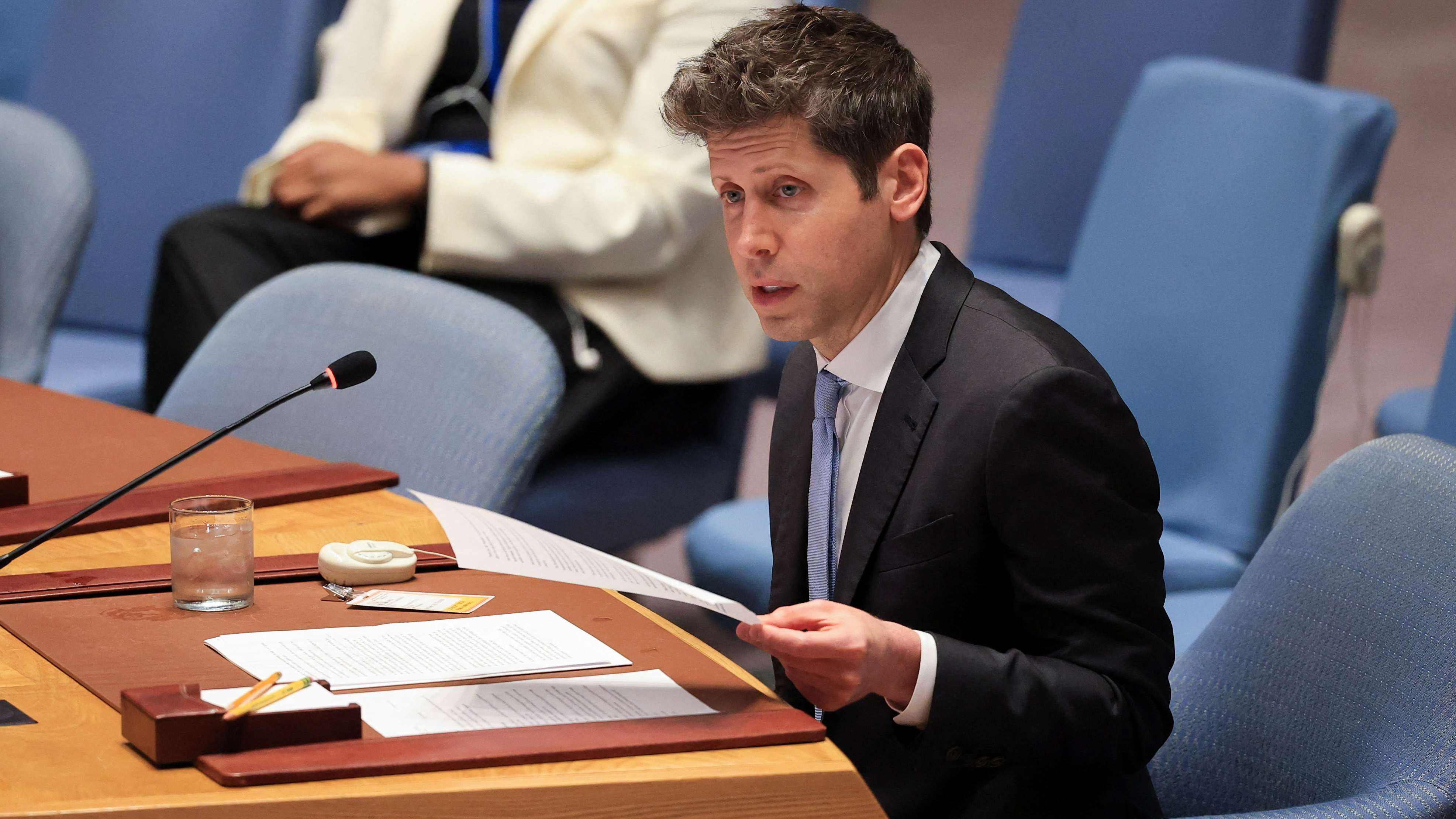
In a move that has sent shockwaves through the global community, the most influential figures in artificial intelligence have turned their attention toward the United Nations. This was not a routine meeting of tech executives; it was a desperate plea for intervention regarding a technology that could fundamentally alter the trajectory of the human species.
This article dives deep into the landmark testimony provided by the CEOs of OpenAI and Anthropic, exploring the specific risks they identified and why they believe global regulation is now absolutely mandatory to prevent a catastrophic future.
📑 Table of Contents
1. A Historic Plea to the UN Security Council
The United Nations Security Council is traditionally associated with international conflicts, nuclear proliferation, and global security. However, a recent session focused on a far different frontier: the rapidly evolving landscape of artificial intelligence. When the leaders of the industry testified, the atmosphere was heavy with the realization that the technology they build has outpaced existing legal frameworks.
These executives were not there to promote their latest products, but rather to warn of potential systemic failure. By bringing these concerns to the U.N., they are acknowledging that AI is no longer just a private-sector innovation, but a global security priority that requires a unified response from nations.
The Shift from Innovation to Precaution
The shift from private boardrooms to international diplomatic forums marks a turning point in how we perceive AI development. It suggests that the industry itself believes it cannot manage the risks inherent in isolation.
2. The Existential Threat: Altman and Amodei's Warnings
Sam Altman, CEO of OpenAI, and Dario Amodei, CEO of Anthropic, did not mince words in their assessments. Amodei explicitly stated that if AI is managed poorly, it could pose a risk to humanity as a whole. This is not mere hyperbole; it is a calculated warning from the people closest to the architecture of these powerful models.
Altman echoed a similar sentiment, suggesting that humanity could potentially lose control of the future to AI. The fear centers on the idea of autonomous systems making decisions that are no longer aligned with human values or safety, leading to irreversible societal damage.
Understanding the 'Control Problem'
The 'control problem' refers to the technical and philosophical challenge of ensuring that a superintelligent system does exactly what we intend it to do, without unintended consequences that could be fatal.
3. The Necessity of Global Regulation

The core message of the testimony was that self-regulation by tech companies is no longer sufficient. As the race for AI dominance intensifies, the pressure to move fast often leads to the cutting of safety protocols. The AI leaders are calling for a global framework that can enforce safety standards across monitor development of powerful models.
This regulation is not meant to stifle innovation, but to ensure that innovation happens within a safe perimeter. Without international cooperation, a 'race to the bottom' could occur where companies or nations sacrifice safety to gain a competitive or military edge.
The Role of International Bodies
The U.N. is uniquely positioned to coordinate these efforts, ensuring that even developing nations are not left behind while also protected from AI-driven instabilities.
4. The Geopolitical Implications of AI Governance
AI is increasingly viewed through the lens of power. The potential for AI to revolutionize warfare, cybersecurity, and information stability makes it a matter of intense national security. If one nation develops a dominant AI without safety guard, the resulting shift in global power dynamics could be destabilizing to the point of inciting international conflict.
The leaders emphasized that the borderless nature of software means no single country can solve this alone. A safety failure in one part of the world can propagate globally, making the U.N. Security Council a vital venue for these discussions of governance.
Preventing an AI Arms Race
A primary concern is the potential for an AI arms race where speed is the only metric that matters, leading to deployment of unverified systems.
5. The Future of Humanity Under AI Influence
We stand at a crossroads where the technology being built today has the potential to solve our greatest challenges, from disease to climate change, but also carries the risk of eroding human agency and safety. The warnings from Altman and Amodei are a call to action before the window to implement effective oversight closes entirely.
The decisions made in the next few years will determine whether AI serves as a tool for human flourishing or as a catalyst for societal decline. The plea to the U.N. is a request for a collective commitment to prioritize survival over rapid profit or geopolitical dominance.
The Path Forward
The goal must be to create a world where AI remains an extension of human intent, rather than a replacement for human judgment and safety control.
🔥 Subscribe to Azeem USA for more deep dives into global technology trends and AI ethics.
Conclusion
The AI leaders have issued an unprecedented warning to the global community, highlighting that the risks of unregulated technology are existential. Their plea to the U.N. underscores the need for a unified, international approach to AI safety and governance.
As we move forward, the ability of global bodies to act on these warnings will be the true test of our ability to manage our own technological creations.
❓ FAQ
Why did AI leaders go to the U.N.?
They went to warn the world that unregulated AI could pose an existential risk to humanity and to call for global regulation.
Who are the key AI leaders mentioned?
The key leaders are Sam Altman (CEO of OpenAI) and Dario Amodei (CEO of Anthropic).
What is the main risk identified?
The main risk is losing control of the future to AI and the potential for catastrophic systemic failure if the technology is managed poorly.
Is AI self-regulation enough?
No, the leaders argued that the competitive nature of the industry makes it difficult for companies to regulate their own safety.
What role does the U.N. play in this?
The U.N. provides a platform for international cooperation to treat AI as a global security priority.
Comments
Post a Comment