
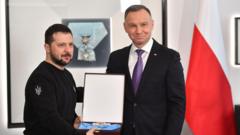
In the complex world of international diplomacy, symbols often carry more weight than a thousand words. The recent move by Ukrainian President Volodymyr Zelensky to return Poland's highest state honor has sent shockwaves through the European political landscape. This is not merely a bureaucratic exchange but a profound acknowledgment of the deep-seated historical complexities that bind two allied nations.
In this comprehensive analysis, we explore the intricate reasons behind this decision, the historical grievances that prompted the move, and how this development might reshape the strategic partnership between Kyiv and Warsaw during a critical time for Ukraine.
📑 Table of Contents
1. The Significance of the Gesture
The decision to return the Order of White Eagle is a rare and highly symbolic political act. Typically awarded to individuals who have made extraordinary contributions to the Polish state, the medal represents the pinnacle of diplomatic recognition from Poland. By returning it, Zelensky is signaling that the current state of bilateral relations requires a level of transparency that transcends ceremonial gestures.
This move comes at a time when Poland remains one of Ukraine's most vocal and vital supporters in the fight against Russian aggression. The gesture highlights that even the strongest alliances are subject to historical narratives that have not yet been fully addressed or reconciled.
Symbolism in Modern Statecraft
The act of returning an award serves as a powerful message to both domestic and international audiences that true reconciliation cannot happen without a foundation of honest acknowledgment of past conflicts.
2. The Weight of History: Volhynia Tensions
The core of the recent friction lies in the tragic events of the Volhynia massacre during World War II. During the early 1940s, thousands of Polish civilians were killed by the Ukrainian Insurgent Army (UPA). For many Poles, these events are viewed as a national tragedy that demands formal recognition and justice.
Conversely, Ukrainian perspectives often view these events through the lens of a broader struggle for independence against multiple occupying powers. The inability to reach a unified historical narrative between Kyiv and Warsaw has created a rift that persists across generations, occasionally resurfacing during moments of high political sensitivity.
The Legacy of Unresolved Conflict
How a nation chooses to remember its past often dictates its current foreign policy, making historical memory a central pillar of modern-day diplomacy.
3. Diplomatic Implications Amid War

The timing of this decision is particularly striking. Ukraine is currently fighting an existential war, and Poland has served as a primary hub for Western aid, weaponry, and refugee support. Any perceived strain in this relationship is viewed by analysts as a potential destabilizer for the front lines of European defense.
However, Zelensky's approach suggests that ignoring these tensions would only lead to a fragile alliance. By addressing these issues now, he is attempting to ensure that the future integration of Ukraine into the European Union is built on a solid foundation rather than on unresolved grievances.
Strategic Unity vs.Historical Truth
The challenge for both leaders is balancing the immediate military need for unity with the long-term political need for domestic historical closure.
4. Engagement with 'Difficult Chapters'
Zelensky has explicitly stated that Ukraine is open to 'engagement' regarding 'difficult and painful chapters of our shared past.' This statement marks a shift from defensive rhetoric toward a proactive diplomatic-historical approach. It suggests a willingness to commission historical studies and foster dialogues that deconstruct conflicting narratives.
This engagement requires immense political will from both sides, as it involves touching upon national identities and collective traumas. The goal is to create a shared framework where both nations can acknowledge the suffering of the other without compromising their own security or national pride.
The Path to Bilateral Reconciliation
Moving forward, engagement is not about forgetting the past, but about a courageous confrontation with the uncomfortable truths of shared history.
5. The Future of Ukraine-Poland Relations
The long-term trajectory of Ukraine-Polish relations will define the security of Eastern Europe. If these two nations can navigate these historical hurdles, they will create a powerful, resilient partnership based on mutual respect and shared honesty. The return of the medal could be the first step in a much larger transformative process.
If the process fails, the resulting friction could be exploited by external actors seeking to drive wedge between allies. However, the current tone from Kyiv suggests a belief that the pain of confrontation is preferable to the long-term danger of an unacknowledged conflict.
A New European Paradigm
The success of this diplomatic effort will serve as a blueprint for how other nations with shared historical conflicts can move toward integration.
🔥 Subscribe to Azeem-USA for more in-depth analysis of global geopolitical shifts.
Conclusion
The return of the highest Polish honour by President Zelensky is a bold move that acknowledges the complexity of Ukrainian-Polish history. While it highlights deep wounds, it also opens a door for a more mature and honest relationship between two vital allies.
As the world watches, the ability of these nations to navigate these 'difficult chapters' will determine the strength of the European security architecture for decades.
❓ FAQ
Why did President Zelensky return the Polish medal?
He returned it to signal the need to address difficult historical chapters, specifically the Volhynia massacre.
What is the Volhynia massacre?
It refers to a series of ethnic cleansing operations during WWII where Polish civilians were killed by Ukrainian nationalist forces.
Does this affect Polish military support for Ukraine?
Currently, Poland remains a key supporter; both nations emphasize the strategic importance of their alliance despite historical tensions.
What is the Order of White Eagle?
It is the highest civilian state decoration of the Republic of Poland.
Will Ukraine and Poland work on their history together?
Yes, Zelensky has expressed an openness to engagement and dialogue regarding their shared painful past.
Comments
Post a Comment