
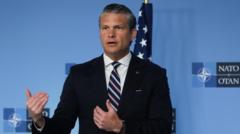
The geopolitical landscape is in constant flux, and recent developments surrounding the United States' commitment to NATO are generating significant discussion. Pete Hegseth, a prominent voice often associated with a more nationalistic foreign policy approach, has once again voiced strong criticisms of the North Atlantic Treaty Organization, suggesting that the U.S. may be poised to re-evaluate its extensive military presence in Europe.
This developing narrative, underscored by the U.S. defense secretary's recent decisions to scale back commitments to a high-readiness force within the alliance, signals a potential inflection point in decades of transatlantic security cooperation. Understanding the nuances of these critiques and their potential impact is crucial for comprehending the future of global defense alliances.
📑 Table of Contents
1. The Shifting Sands of Transatlantic Defense
For decades, the United States has been the cornerstone of NATO, providing significant military might, logistical support, and strategic leadership. This commitment has been a defining feature of post-World War II global security, aimed at deterring aggression and fostering stability across Europe. However, the internal political dynamics within the U.S. have increasingly led to questions about the sustainability and desirability of such extensive overseas military commitments.
The recent announcement regarding a reduction in commitments to a high-readiness force within NATO is not an isolated event but rather a symptom of a broader reassessment of America's role in global security. This move suggests a strategic pivot, where the focus may be shifting towards domestic priorities or a more selective engagement abroad. The implications are far-reaching, prompting allies and adversaries alike to recalibrate their expectations and strategies.
The Historical Context of US Engagement
The post-war era saw the U.S. embed itself deeply within European defense structures, largely as a bulwark against Soviet expansion. This presence was built on mutual defense pacts and a shared vision of democratic values. However, the dissolution of the Soviet Union fundamentally altered the security calculus, leading to ongoing debates about the necessity of maintaining such a large footprint.
2. Hegseth's Core Criticisms and the "America First" Echo
Pete Hegseth's renewed criticism taps into a sentiment that has been gaining traction within certain political circles in the United States. His arguments often center on the idea that American resources and military personnel are overextended, potentially at the expense of domestic needs and national interests. This perspective frequently echoes the broader "America First" philosophy, which prioritizes national sovereignty and a more transactional approach to international alliances.
The core of Hegseth's critique appears to revolve around the perceived burden-sharing within NATO, questioning whether European allies are contributing their fair share to collective security. He has voiced concerns that the U.S. is carrying a disproportionate load, both financially and in terms of military deployment, without receiving commensurate benefits or a sufficient commitment from other member states. This viewpoint suggests that U.S. involvement in NATO might be viewed as a costly engagement that does not directly serve core American security imperatives.
Questioning the Value Proposition of NATO
At the heart of these criticisms lies a fundamental question about the value proposition of NATO in the current geopolitical climate. With evolving threats, from cyber warfare to asymmetrical conflicts, and shifting power dynamics, some argue that the traditional alliance structure may be less relevant or require significant adaptation. Hegseth's stance implies that a thorough review of NATO's effectiveness and the specific benefits it provides to the United States is long overdue.
3. The Implications of a Scaled-Back US Commitment

A significant reduction in the U.S. military presence in Europe would undoubtedly send ripples across the continent and beyond. For decades, the U.S. military presence has served as a powerful deterrent, a reassurance to allies, and a critical component of the continent's security architecture. Its withdrawal or substantial scaling back could create power vacuums and embolden potential adversaries, leading to increased instability.
European nations, many of whom rely heavily on the U.S. security umbrella, would face immense pressure to enhance their own defense capabilities and potentially forge new security arrangements. This could lead to a fragmentation of security efforts or, conversely, spur greater European integration in defense matters. The economic impact, from defense spending to trade relationships, would also be considerable, as security and economic stability are inextricably linked.
Potential for Increased Regional Tensions
The absence of a robust U.S. presence could lower the threshold for regional conflicts. Without the overarching security guarantee, neighboring countries might feel more emboldened to pursue assertive policies, leading to heightened tensions and a potential arms race. The delicate balance of power in Eastern Europe, in particular, could be significantly disrupted, creating new flashpoints.
4. Europe's Response and Strategic Autonomy
The prospect of a reduced U.S. commitment has long been a topic of discussion within European capitals, often framed as the need for "strategic autonomy." This concept refers to the European Union's aspiration to develop its own independent capacity to act on the global stage, particularly in defense and security, without being solely reliant on the United States. Hegseth's criticisms and the recent defense decisions could serve as a powerful catalyst for accelerating these efforts.
European nations would need to significantly increase defense spending, enhance interoperability between their armed forces, and develop more robust command and control structures. This would require a level of political will and financial investment that has historically been challenging to achieve. The effectiveness of such a move would depend on the willingness of individual member states to cede some sovereignty and coordinate their defense policies more closely.
The Challenge of Burden Sharing Within Europe
Even if Europe were to bolster its own defense capabilities, the challenge of equitable burden-sharing would persist. Historically, some European nations have been criticized for underinvesting in defense. A shift in U.S. policy would necessitate a fundamental re-evaluation of national defense budgets and priorities across the continent, potentially leading to friction between allies regarding contributions and responsibilities.
5. Navigating the Future: A New Era for NATO?
The ongoing debate surrounding U.S. involvement in NATO and the critiques voiced by figures like Pete Hegseth signal a potential turning point for the alliance. The future of NATO may depend on its ability to adapt to evolving threats and to address the concerns of its most powerful member. This could involve redefining its mission, enhancing its flexibility, and ensuring that all members are perceived to be contributing equitably.
Regardless of the specific outcomes, the current discussions highlight the dynamic nature of international relations and the constant need for alliances to reassess their purpose and effectiveness. The United States' role in global security remains pivotal, but the terms and conditions of that involvement are clearly subject to continuous scrutiny and potential revision, demanding a forward-thinking approach from all stakeholders in the transatlantic community.
The Need for Dialogue and Adaptation
Ultimately, the future of transatlantic security hinges on open dialogue, mutual understanding, and a willingness to adapt. Both the U.S. and its European allies must engage in constructive conversations to address concerns, identify shared interests, and forge a path forward that ensures collective security in an increasingly complex world. The alliance's resilience will be tested, requiring a commitment to diplomacy and strategic foresight.
🔥 Stay informed on critical global security developments by following Azeem USA.
Conclusion
Pete Hegseth's renewed criticism of NATO and the U.S. defense secretary's moves to scale back commitments signal a critical juncture for transatlantic security. The potential for a U.S. review of its European presence necessitates a sober assessment of the alliance's future role and the responsibilities of its member states.
As the geopolitical landscape continues to evolve, the ability of NATO to adapt, address internal concerns, and demonstrate its continued relevance will be paramount. The coming months and years will likely be defined by strategic recalibrations and a renewed focus on the balance of global defense commitments, demanding thoughtful consideration from all involved parties.
❓ FAQ
Who is Pete Hegseth and why is he critical of NATO?
Pete Hegseth is a prominent conservative commentator and former U.S. Army officer. He often voices criticisms of NATO, arguing that the U.S. bears an unfair burden in the alliance and that resources could be better utilized domestically or for more targeted security interests, reflecting an 'America First' perspective.
What specific actions has the US taken recently regarding NATO readiness?
Recent reports indicate that the U.S. defense secretary has made decisions to scale back commitments to a high-readiness force within NATO. This suggests a reduction in the immediate availability or deployment posture of certain U.S. military assets dedicated to the alliance.
What does 'strategic autonomy' mean for Europe in this context?
Strategic autonomy for Europe refers to the EU's goal of developing its own independent capacity to act on security and defense matters, reducing reliance on the United States. This involves increasing defense spending, improving military capabilities, and fostering greater coordination among European nations.
What are the potential consequences if the US reduces its presence in Europe?
A reduced U.S. presence could create security vacuums, potentially embolden adversaries, and lead to increased instability in Europe. European nations would face greater pressure to enhance their own defense capabilities and might need to forge new security arrangements.
How might NATO adapt to these changing dynamics?
NATO may need to adapt by redefining its mission, enhancing its flexibility to address new threats, and ensuring more equitable burden-sharing among member states. Open dialogue and a willingness to evolve will be crucial for the alliance's future effectiveness.
Comments
Post a Comment